Sheaf Theory Perspectives: Insights and Applications
This post provides an approachable overview of the recent paper “Sheaf theory: from deep geometry to deep learning” written by Anton Ayzenberg, Thomas Gebhart, German Magai, Grigory Solomadin about sheaf theory and its applications. The paper itself is much broader than a typical overview, includes a detailed mathematical introduction, and a number of new mathematical results.
As exciting as that may be for many of you, this post will focus on more practical sheaves applications in various fields. We will first give a high-level introduction to sheaf theory, defining the basic concept, then move on to sheaf-based perspectives on deep learning. Then, we will describe more specific applications in logic, theoretical CS, and applied topology.
What is Sheaf Theory?
Sheaf theory stands at the intersection of geometry, algebra, and category theory. It provides an approach to transition from a geometric object G to a category V (finite sets, vector spaces, etc.). Informally, sheaf assigns to each object of G an object from a category V. In practice, this immerses G into a computationally rich environment V, enabling effective signal representation and processing.
The environment V is usually of an algebraic type, so in simpler terms: sheaf theory allows us to “algebraize” geometric structures.
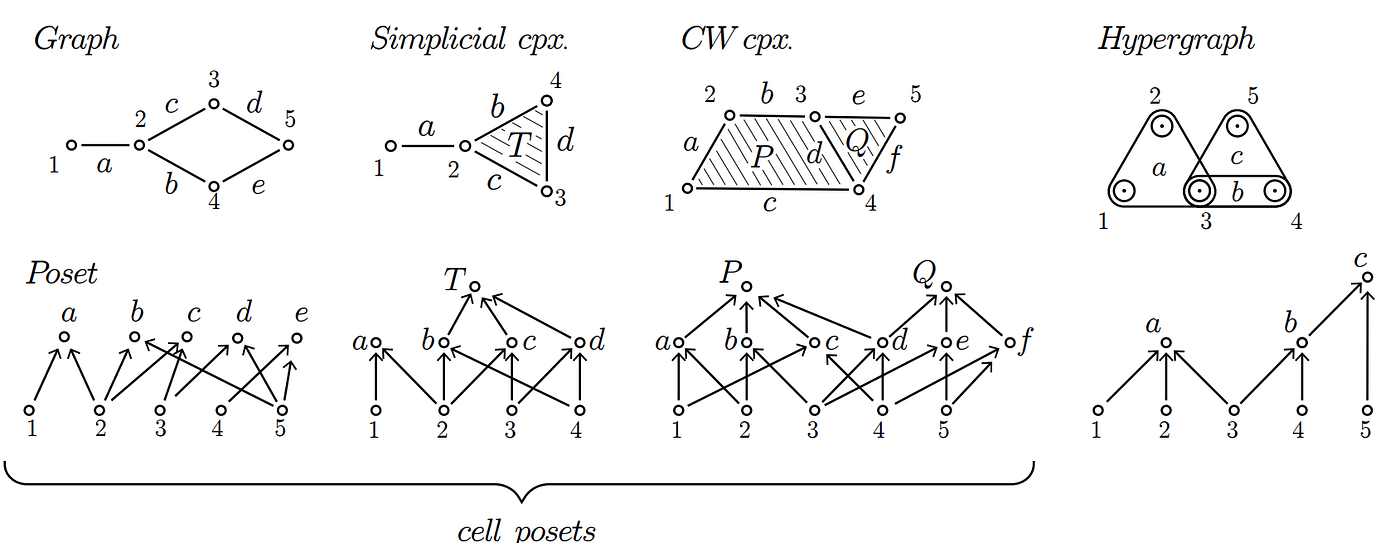
In data science and machine learning, choosing the right geometric structure is crucial for representing knowledge efficiently. This becomes particularly important when extracting embeddings from data using. While graphs can represent simple relations, complex data demands richer structures: hypergraphs, cellular complexes, or simplicial complexes. This perspective forms the foundation of the emerging Topological Deep Learning field, see M. Hajij [1] for details. All these structures (figure 1) can be efficiently represented as partially ordered sets (posets), denoted by S(G). This generalization is why we formulate sheaf theory over posets.
Sheaf Definition (Don’t Panic!)
Without going into full details, for a poset S and target category V, a sheaf D is a functor: D: S → V that is
- For s in S we have an object D(s) of V called a stalk at s.
- For each pair s_1 < s2, we have a mapping: D(s1) → D(s2) called a restriction map.
- Vector space V_n assigned to each node n and vector space V_e assigned to each edge e.
- Linear maps from nodes to edges: F_{ne} whenever n is an endpoint of e. A map F_{ne} is given by a matrix of appropriate size.
![Figure 2. A twisted sheaf demonstrates strict inclusion [32]](figure-2.png)
In Figure 2 Example of a sheaf over a cycle graph on 3 nodes. Each node of a graph is assigned a 1-dimensional vector space, and whenever a nodes lies in an edge, we have a 1x1-matrix specified, that is just a single real number. Multiplication by -1 is shown by twisting the real line.
Global Sections and Sheaf Diffusion: Local Becomes Global
This idea implements a “local-to-global” conceptual framework where local coherence implies global coherence. It can be used as a reasoning scheme for solving problems on systems that require finding a equilibrium state.
🧐 Thus, sheaf theory is a special perspective, a point of view from which one can look at different objects, problems and theories.
Finding global coherent state T is crucial to model situations where a consensus of some complex system needs to be described. A common method for finding a global coherent state is sheaf diffusion. Its idea is simple: the notion of Dirichlet energy is introduced, it measures deviation of the system from equilibrium (coherent state). Dirichlet energy is a convex quadratic function, and its corresponding nonnegative symmetric matrix is called the sheaf Laplacian. Sheaf diffusion is essentially gradient descent for Dirichlet energy. Convergence rate of sheaf diffusion is determined by the spectrum of the sheaf Laplacian and reveals insights about the geometry of the underlying structure G.
🤔Interesting fact. A sheaf is called constant 1-dimensional if the vector spaces V_n and V_e are assigned to all nodes and all edges of a graph G are 1-dimensional, and all restriction maps F_{ne} are the identity maps. In this case, sheaf Laplacian becomes the graph Laplacian, and sheaf diffusion becomes the equation of heat diffusion on a graph. In this sense, sheaf theory on graphs (together with Laplacians and diffusion) can be considered a generalization of Spectral Graph Theory, where each node and each edge of a graph can store not just one parameter (like temperature) but multiple real-valued parameters. The restriction maps of a sheaf encode how information circulates between nodes.
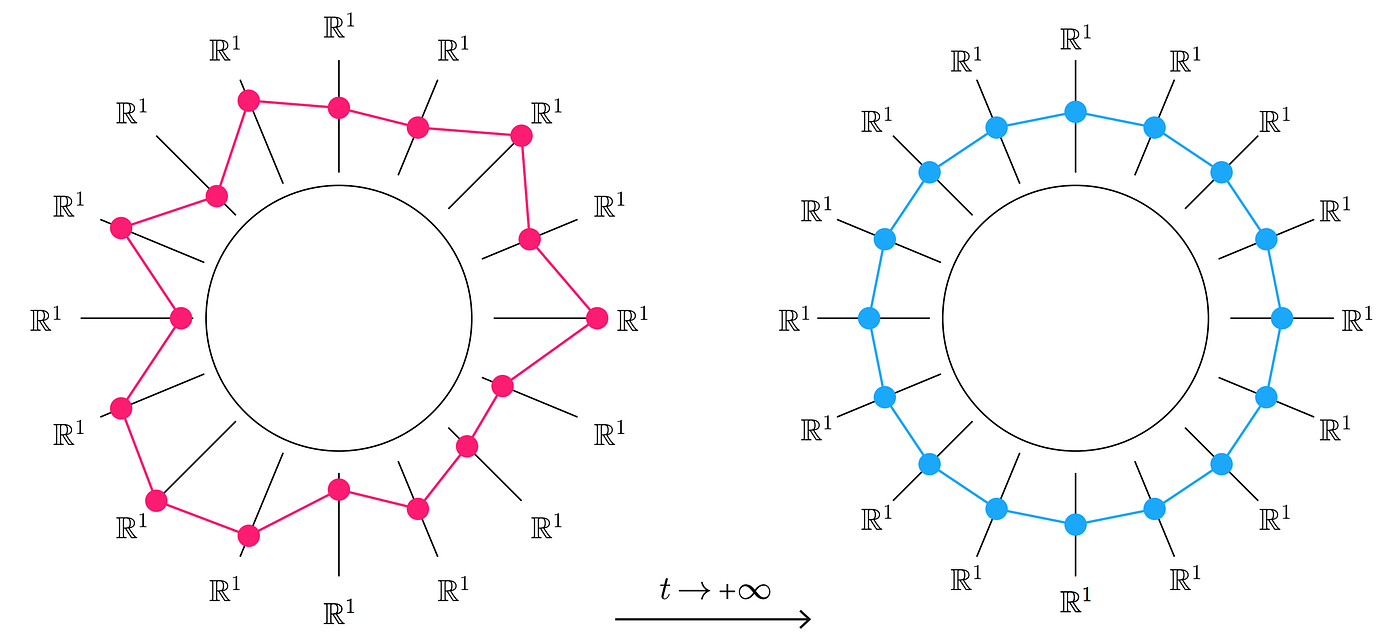
Heat diffusion is a process defined locally, in a way that temperature at each point becomes closer to the intermediate temperature of its neighbors (figure 3). Not surprisingly, all points of each connected component of a graph attain the same temperature eventually (as time tends to +infinity).
Sheaf’s insight for Deep learning
The concept of a sheaf formed the basis for the design of Graph Neural Network (GNN) type architectures, which are called Sheaf Neural Networks (SNN) or Sheaf-based NN. The first GNN incorporating sheaf-based inductive bias was proposed in [2]. It used a predefined restriction map with a non-constant sheaf to construct a GNN.
Building upon this work, Bodnar et al. introduced the Neural Sheaf Diffusion (NSD) architecture [3], which is based on sheaf diffusion process. Sheaves are learned during training stage. Their research showed that NSD, which relies on the sheaf Laplacian (a generalization of graph Laplacian), is significantly more expressive and powerful than traditional Graph Convolutional Networks (GCNs). In particular, trivial sheaf (with identity restriction maps) corresponds to traditional GCN.
Remember the local-to-global philosophy mentioned above? The learning process of the NSD can be viewed from this perspective in a practical sense. The NSD learns restriction maps (matrix) that ensure consistency between local states on nodes (figure 4), reaching a coherent state.
![Figure 4. Illustration of stalks on nodes and edges, with corresponding restriction maps Φ [3]](figure-4.png)
Notably, NSD effectively tackles two common challenges in graph learning. First is over-smoothing where node representations become too similar after multiple layer stacking. The next one is heterophily where graph connected nodes may differ significantly from one another. The problem of GNN limitation for heterophilic graphs are discussed in detail in [4].
In this regard, NSD outperforms on node classification tasks over other GNN-based approaches such as GAT, GCN, GraphSAGE and etc., on several real-world graph datasets characterized by high heterophily (e.g. Texas, Cornell, Squirrel). However, it systematically underperforms on datasets with high homophily, such as Core, CiteSeer, and PubMed. This represents the first instance of applying SNNs to real graph learning tasks.
The core idea behind SNNs: Unlike traditional GCNs, which propagate embeddings directly, SNN introduce restriction maps that explicitly define how information is transformed between connected nodes. Restriction maps enable a more structured message passing within the graph, enhancing the model’s expressiveness and effectiveness in capturing complex relationships between nodes in graphs with complex topologies.
If we place it in a DL scientific context, SNN falls under the broader umbrella of Geometric Deep Learning field, see Bronstein et al. Geometric deep learning book [5] for a deep introduction.
NSD has opened a new frontier in the research of SNN and their modifications. When designing new SNN architectures, various geometrical and topological constructs, as well as engineering tricks, are employed to enhance the capabilities of vanilla SNNs, address their limitations, and enable them to outperform current GNN-based SOTA models on different graph processing tasks.
- Barbero et al in [6] manually constructs restriction maps based on the geometry of neighbor node embeddings under a manifold assumption, demonstrating a clear improvement in SNN performance.
- Sheaf Attention Network (SheafAN) integrates attention mechanisms from Graph Attention Networks (GAT) into SNN models [7]. Results indicate that SheafAN improve classical GAT and achieves competitive performance to other GNN methods on several datasets.
- The SNN is adapted to the geometric structure of the hypergraphs in the work [8]. In this setting a linear Laplacian is defined for the Sheaf Hypergraph Neural Network. Notably, it consistently outperforms other GNN-based models across datasets with all heterophily levels highlighting effectiveness of SNN beyond tasks on heterophilic graphs.
- Node positional encodings (PEs) provide GCN with information about the global position of each node in the graph. Work [9] introduces a PE construction method based on the sheaf Laplacian, resulting in improved performance compared to standard GCN without PE.
The examples above convincingly show that adding the sheaf-based inductive bias to the well-known GNN-type architectures and techniques from graph learning certainly improves performance.
Real-world Applications of Sheaf Neural Networks
While previously we considered modifications of SNN, we will now focus on the currently active direction of applying SNNs to the real-world problems. Sheaf theory has several tangible usage applications:
- Multi-document summarization — aggregation of information from several documents into a short summary. The FABRIC model tackles this task, combining simplicial complex layers, BART text encoding, and Sheaf Graph Attention to model complex semantic relations [10].
- Recommendation systems. The Sheaf4Rec framework proposed in [11] applies Cellular Sheaf to recommendation systems, providing a more efficient representation of user-item interactions than GNN. Sheaf4Rec shows performance improvements on the Yahoo and MovieLens data.
- Personalized Federated Learning (PFL)delivers unique parameters to clients in a federation based on their local data distribution. This is especially relevant to sheaf local-to-global philosophy, as several works applied the sheaf-type DNN for this task. Sheaf Hyper Networks [12] and FedSheafHN [13] approaches integrate sheaf structures in Graph Hyper Networks and achieve high performance in the PFL tasks.
- Inconsistency detection involves identifying contradictions within a system of documents. The work [14] investigates the application of sheaf theory in combine with Large Language Models to assess global logical consistency across document corpora in jurisprudence domain.
Representation Learning and Interpretability
Sheaves also provide a unique lens for understanding DNN representations and interpretability. Gebhart et al. [15] demonstrated that cellular sheaf theory offers a framework where many knowledge graph embedding approaches can be viewed as sheaf learning problems.
![Figure 5. Overview of the embedding inductive learning [37]](figure-5.png)
This also has found an application in work [16] extended this approach to inductive learning, showing that optimal embeddings for new nodes added to a knowledge graph can be inferred with harmonic extension using the sheaf Laplacian (figure 5). Work [17] proposed a sheaf-theoretical approach to understanding ML models by defining sheaves on data through topologies with an open set corresponding to related point subsets.
It should be noted, the range of existing real-world applications of SNN is limited and the results are not always very significantly superior to SOTA GNN-based approaches. However, we believe that sheaves have the potential to be a powerful and baseline tool in the field of graph learning. It is more than just a heuristic; it is a conceptual framework that provides a general perspective on the problem of graph representation learning.
Here we examine applications of sheaf theory in specialized areas such as logic, computer science, and signal processing.
Applications in Logic and Computer Science
In discrete computing, sheaves on a given structure valued in a category of sets form a topos, i.e. a category corresponding to a logical theory. This abstraction is particularly important for logical systems. Specifically, sheaf theory provides semantics for intuitionistic logic, connecting with type theory and programming language theory [18].
Most interestingly, sheaves form the mathematical basis for categorical foundations in computer science, a direction which has its roots in [19].
Sheaves have been applied [20] in some classes of lambda calculi, particularly for lambda expression normalization algorithms that compare lambda-expressions without relying on syntactic reduction.
Algorithms inspired by the Local-to-Global
Sheaves embody a local-to-global conceptual framework where local coherence in a geometric object assembles into global equilibrium.
A bit like how individual bees follow simple rules collectively to build complex hives–except with more mathematical notation and fewer stingers.
An example of an implementation of this idea was proposed by Srinivas [21], where the classical Knuth–Morris–Pratt string matching algorithm is reinterpreted in the language of sheaves over Grothendieck topologies and generalized from strings to other data structures, so that it can be used in subgraph matching and other pattern matching problems.
Sheaf ideas also inspired modern approaches to pattern matching, constraint satisfaction problems and structure isomorphism tests in the works by Conghaile [22] and Abramsky [23]. The sheaf’s local-to-global principle has been recently applied in a computational linguistic [24].
Applied topology and Signal processing
For data analysis and signal processing, we typically consider sheaves valued in the category of vector spaces. The modern direction of applying topology to data-driven and signal processing problems originated with Ghrist [25], Curry [26], and Robinson [27].
Subsequent research [28] proposed applying sheaves to network flow problems. Curry advanced the conceptual direction of sheaves and co-sheaves on cellular complexes [26], laying the groundwork for modern deep learning applications. A fundamental development was the emergence of spectral theory for cell sheaves in Hansen and Ghrist’s work [29], showing that the Sheaf Laplacian has properties useful for calculating global sections for cellular sheaves. The intersection of Topological Data Analysis and Sheaf theory led to persistent sheaf Laplacians [30].
Recently, the research of sheaf Laplacians was adapted by Ghrist and Riess to sheaves valued in category of lattices (leading to the notion of Tarski Laplacian) [31] and categories enriched over quantales (leading to the notion of Lawvere Laplacian and categorical diffusion) [32]. Using discrete objects instead of vector spaces allows one to state many graph algorithms, (e.g. Dijkstra’s) as the search of a consensus of a complex system.
Sheaf Cohomology Applications
For a sheaf D on a geometrical structure S valued in the category of vector spaces, the collection Γ(S; D) of all global sections is a vector space itself; it enumerates equilibrium states of the medium D. This space belongs to a potentially infinite sequence of vector spaces
Γ(S; D) = H⁰ (S; D), H¹ (S; D), H² (S; D), etc.,
called sheaf cohomology. While elements of H⁰(S; D) are treated as potential consensus states, elements of H¹(S;D), the 1-st degree cohomology, can be understood as linear relations between consensus states, elements of H²(S;D) as relations between relations, and so on. Sheaves on graphs do not have cohomology in degrees > 1, because a graph is a 1-dimensional object. However, even H¹(G;D) carries important information about the topology of a graph G.
💡Notes. For higher-dimensional data structures cohomology of high degrees carry important information about higher order interactions between points. It is relatively easy to compute sheaf cohomology over the so called cell complexes, higher dimensional generalization of graphs. Simplicial complexes, polyhedral surfaces, quad meshes, — mathematical abstractions known to specialists in computer graphics, computational geometry, and scientific engineering — are all examples of cell complexes.
A number of nontrivial applications of higher order sheaf cohomology was proposed in the literature. In [33] sheaf cohomology was applied to scheduling tasks in complex manufacturing and supply chains. Cohomology measures the extent to which optimal schedules for parts of the production fail to patch into a globally optimal schedule.
![Figure 6. Stresses in beam constructions are modeled by sheaves [34].](figure-6.png)
Cooperband and Ghrist [34] proposed an application of cellular sheaf cohomology (and sheaf homology!) in the modelling and engineering of truss and beam constructions and mechanisms (figure 6). Here the stalks of a sheaf represent the degrees of freedom for each part of a mechanism, and restriction maps encode the constraints imposed by the structure. Cohomology of such a sheaf models the degrees of freedom (the real vector) of the whole construction.
If you see a scaffold accidentally crumble under a builder you know this happened due to nontrivial cohomology of the related sheaf.
The idea of describing degrees of freedom through sheaf cohomology has found an aesthetic application in origami modelling [35] which is recently considered an important part of industrial design. Molecules studied in biophysics are yet another example of a constrained mechanical structure. Diffusion on sheaves specified by such systems successfully models equations of molecular dynamics [36].
In Conclusion
Sheaf theory is a powerful mathematical framework built upon geometry, algebra, categories and a lot of other fancy clever stuff. Surprisingly, its applications span from theoretical computer science to cutting-edge deep learning architectures solving real-world problems.
We invite everyone to explore the intricate world of sheaves!